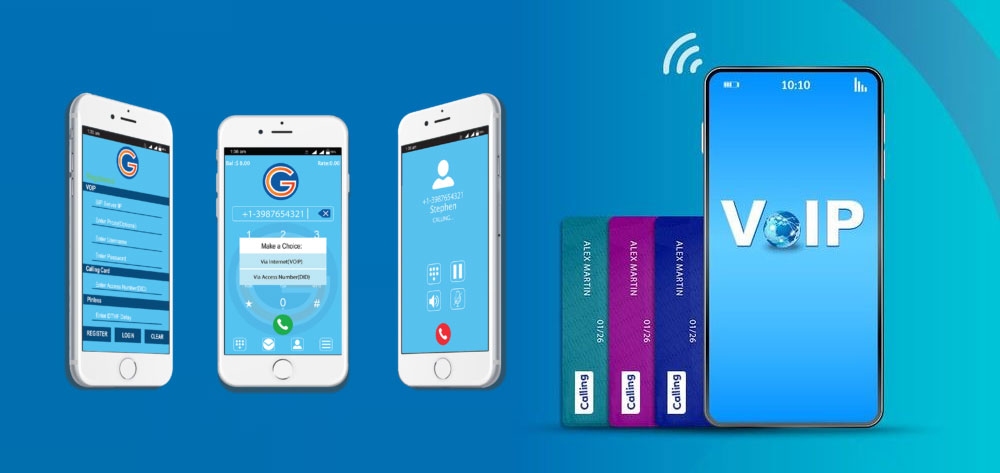

White-Label Solutions

calling card system

Cloud Mobile Softphone Explained: Architecture, Deployment, and Operational Fit for Distributed Teams

Managing voice communications across a distributed workforce used to mean one of two things: desk phones tethered to an office LAN, or an on-premises PBX system that required a dedicated server room, a maintenance contract, and a reason for employees to be physically present. Neither assumption holds up when half your team works remotely and the other half splits time between office, home, and client sites. A cloud mobile softphone changes the architectural foundation. The telephony stack moves off your premises, your users carry their business lines on devices they already own, and your IT team manages the entire system from a single administrative dashboard. That shift has operational, financial, and security consequences worth understanding before you evaluate vendors or finalize a deployment model. What Is a Cloud Mobile Softphone and How Does It Differ From Traditional Phones? A cloud mobile softphone is a software application that turns any internet-connected device—laptop, smartphone, tablet, or desktop—into a fully functional business phone by connecting it to a hosted cloud PBX rather than physical hardware or an on-premises server. The distinction matters more than it first appears. Traditional desk phones are purpose-built hardware endpoints that register to a PBX—either on-premises or hosted—over a local network. They require physical installation, network drops, power-over-Ethernet switches, and manual provisioning per device. On-premises phone systems can be expensive to set up because of the equipment needed—IP phones, SIP trunking, and a dedicated room in your office for the equipment. When something breaks, either your IT staff fixes it or a third-party vendor does, at cost. On-premises softphones replaced hardware endpoints with software clients, but they still registered to a PBX running inside your building. The calling infrastructure remained local: your server, your maintenance, your problem when a firmware update breaks the SIP stack at 2 a.m. A physical PBX phone system means anyone needing to make calls needs to physically be in the office—remote employees can’t dial in and make or receive calls away from their desks. Cloud softphones move the PBX itself off-premises. Softphones are cloud-based and enable remote business communications, whereas hardphones are premise-based and require employees to be physically in the office to access their business phone system. The phone system lives in the provider’s infrastructure—geo-redundant data centers, managed SIP servers, and cloud-hosted routing logic—while users connect through a lightweight app on the device of their choice. Hosted phone systems are more often more reliable than their traditional counterparts. Your hosted PBX provider is responsible for the maintenance, security, and general upkeep of your cloud phone system. That operational transfer is precisely what makes cloud softphones attractive to IT managers overseeing distributed teams: you offload infrastructure management without sacrificing feature depth. How Cloud Mobile Softphones Work: WebRTC, SIP Clients, and Cloud PBX Integration Cloud mobile softphones communicate using two primary protocol stacks: SIP-based clients that register directly to a cloud PBX, and WebRTC-based clients that route calls through a browser or native app. Understanding the architecture of each helps you make the right deployment decision for your team’s scale and requirements. SIP-Based Cloud Mobile Softphones Traditional mobile softphones introduced businesses to the power of voice-over-IP technology, transforming standard internet connections into sophisticated communication tools. These software-based phone systems operate through the SIP protocol, enabling voice communication over internet networks rather than traditional phone lines. In a cloud deployment, the SIP client on the user’s device registers to a hosted PBX—built on platforms like FreeSWITCH, Asterisk, or Kamailio—over the public internet. The signaling plane (SIP) handles call setup, teardown, and feature negotiation. The media plane (RTP) carries the actual voice packets. A Session Border Controller (SBC) typically sits between your users and the cloud PBX, handling NAT traversal, security enforcement, and protocol translation. Mobile Softphone settings are stored on a cloud server—the provisioning server. Once an agent starts a SIP softphone and logs in with their credentials, the softphone downloads its configuration settings from the server. It takes less than one second. Neither a system administrator nor an agent needs to enter any configuration settings. An agent has a preconfigured application and can start making calls immediately. SIP softphones offer the widest range of functions that are guaranteed to work with any cloud PBX, as well as with specialized server software for a call center. This makes them the preferred choice for organizations running high-volume calling environments, advanced IVR flows, or integration with legacy carrier infrastructure. WebRTC-Based Cloud Mobile Softphones WebRTC (Web Real-Time Communication) takes a different approach. Modern communication platforms powered by WebRTC deliver enhanced capabilities, including superior audio quality, seamless video integration, and robust security features. The technology operates natively within web browsers, eliminating the complexity associated with traditional softphone installations while providing more advanced features and better performance. The fundamental difference lies in WebRTC’s ability to establish peer-to-peer connections directly between browsers. This capability reduces latency, improves call quality, and enables more efficient data transmission compared to traditional softphone solutions. WebRTC’s architecture also includes built-in media processing capabilities and advanced codec support, ensuring superior communication quality across different devices and network conditions. Where WebRTC-based softphones need to connect to a PSTN carrier—for outbound calling to regular phone numbers—they rely on a backend bridge. The backend, running in the cloud or in a private Kubernetes cluster, converts WebRTC into regular VoIP (SIP) so calls can be exchanged with ordinary VoIP systems and carriers. This translation layer is invisible to the end user but critical to the architecture: it means WebRTC endpoints interoperate with SIP carriers, hosted PBXs, and PSTN gateways without requiring users to install SIP clients. With WebRTC, you can call and be called through your browser on your PC or Mac, or through a mobile application, from any location. With web-based solutions, businesses can easily expand to meet growing demand and effectively manage high call traffic. For organizations building or evaluating white-label softphone solutions, Gama Infotech offers cross-platform options—including Android Communicator for OTT VoIP deployments and an iPhone Softphone—designed to integrate with any SIP-compliant cloud PBX or softswitch. Why Distributed

Cloud Mobile Softphone Explained: Architecture, Deployment, and Operational Fit for Distributed Teams Read More »

multi tenant pbx

What Is a Multi-Tenant PBX and Why Does It Power Profitable Hosted VoIP Businesses?

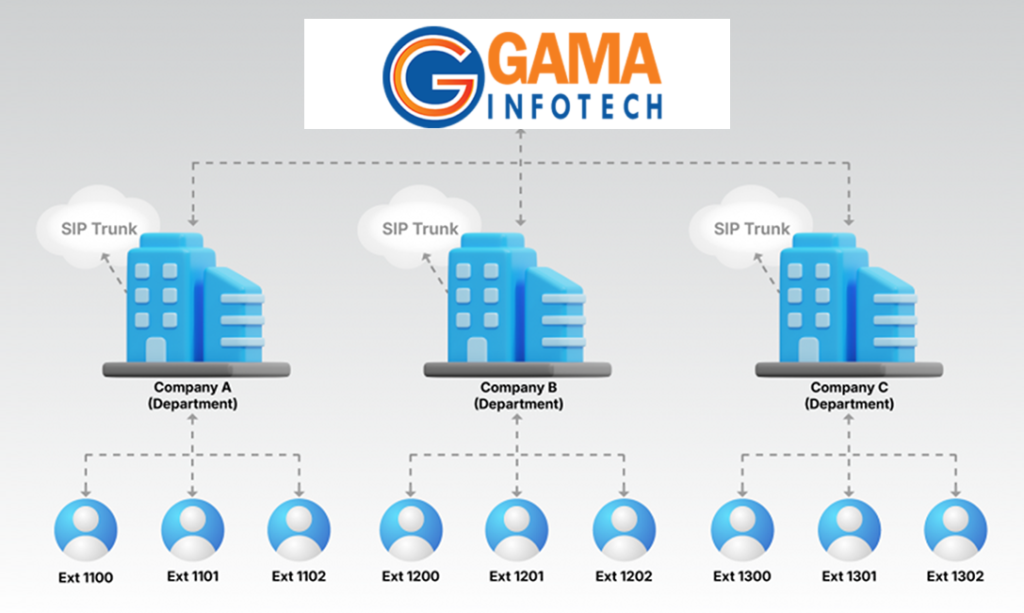
Multi-tenant PBX is not simply a way to save server costs. It is the architectural decision that determines whether a hosted telephony business can scale to hundreds of customers, maintain per-customer isolation, and deliver profitable margins without a corresponding explosion in operational overhead. The hosted PBX market generated an estimated USD 13.2 billion in revenue in 2024, and it is projected to grow at a CAGR of 16.8% from 2025 to 2032. Service providers and technical evaluators who understand how multi-tenancy works at a structural level are far better positioned to build and operate in that market than those who treat it as a generic checkbox. What Is a Multi-Tenant PBX? A multi-tenant PBX is a single hosted telephony platform that simultaneously serves multiple independent business customers—called tenants—on shared underlying infrastructure, while keeping each customer’s data, configuration, and call flows completely separated from every other. A multi-tenant PBX is a phone system where multiple businesses share the same PBX infrastructure. Each tenant is isolated at the software level, with separate user accounts, extensions, call flows, and configurations—but all share the same core system, servers, and resources. The critical word is logical isolation: tenants share physical or cloud compute resources, but the software enforces strict boundaries so that no tenant can see or access another’s environment. The analogy that maps most accurately to the architecture is an apartment building. One massive high-rise building has one central foundation, one main water supply, and one security team—but inside there are separate apartments. Apartment 4B cannot see into Apartment 4C. They share the infrastructure but live in complete privacy. In PBX terms, the building is the server cluster; the apartments are the tenants; and the shared plumbing is the SIP stack, processing power, and memory that serve every customer without any customer owning or accessing those layers directly. This stands in contrast to traditional on-premises telephony, where each business ran its own dedicated hardware. It also differs from a simple “multiple instances” approach, where providers deploy a separate virtual machine per customer—a model that may look multi-tenant from the outside but carries the operational costs of single-tenancy inside. Multi-Tenant vs. Single-Tenant PBX: Key Architectural Differences The choice between these two architectures shapes cost structure, scalability ceilings, security posture, and operational complexity from day one. The core distinction between multi-tenant and single-tenant PBX comes down to how an organization handles matters of growth, data safety, and budget. Here is how the two approaches compare across the dimensions that matter most to service providers and technical evaluators: Dimension Multi-Tenant PBX Single-Tenant PBX Infrastructure Shared servers, SIP stack, and database across all customers Dedicated instance per customer—separate VM or hardware per client Isolation model Logical isolation enforced by software partitioning and access controls Physical or virtual isolation; each instance is fully independent Cost structure Infrastructure costs amortized across multiple tenants, reducing total cost of ownership (TCO) Larger upfront capital expenditure (CapEx) for dedicated hardware or a premium recurring fee for full isolation Provisioning speed Multi-tenant systems often go live in days or weeks Slower; requires provisioning a full instance per customer Update management The provider rolls out new features, bug fixes, and patches centrally; all tenants benefit without scheduling upgrades Updates must be managed per instance; risk of version fragmentation Customization depth Per-tenant configuration within platform limits; some constraints on system-level changes Bespoke workflows, custom call routing, API integrations—tailored end to end Performance isolation Resource pooling benefits idle tenants; “noisy neighbor” risk must be managed with QoS policies Without “noisy neighbors,” guaranteed resource reservations and performance metrics Compliance suitability Strong for most use cases; regulated industries (healthcare, finance) may require additional controls Regulated industries—healthcare (HIPAA), finance (PCI-DSS), government—where data isolation is critical often prefer or require this model Best fit VoIP service providers, MSPs, ITSPs, hosted PBX operators managing many SME clients Large enterprises, high-volume call centers, organizations with bespoke compliance requirements Neither model is universally superior. The choice between single-tenant and multi-tenant IP PBX systems depends on the specific needs of the organization or service provider. Both have advantages and disadvantages. For providers whose business model depends on serving dozens or hundreds of SME customers from a central platform, however, true multi-tenancy is the only architecture that delivers the economics and operational simplicity that makes that model viable. How Multi-Tenancy Works: Shared Infrastructure with Logical Isolation The engineering challenge in multi-tenant PBX is straightforward to state and demanding to execute: use one system to serve many customers, without any customer ever touching another’s data, calls, or configuration. The solution lies in a layered architecture with distinct roles at each level. The Three-Layer Control Model The master node (super admin) is the level accessible only to the multi-tenant PBX provider. From here, the provider creates new tenants, sets global limits such as maximum concurrent calls, and manages billing. Below that sits the tenant partition layer, and within each partition, an optional reseller or tenant admin layer. When a new client is onboarded, the system carves out a virtual slice of the PBX. This partition includes its own database tables or distinct identifiers for users, CDRs (Call Detail Records), and configurations. From the tenant’s perspective, the system looks and behaves exactly like a dedicated PBX. They see only their own extensions, call queues, IVRs, and recordings—because the platform enforces strict namespace separation at the data layer. A multi-tenant architecture uses a single instance of a software application to serve multiple customers. In this model, tenants share common system components—such as security mechanisms, business logic, and resource management—while remaining logically isolated from one another. This isolation ensures that each tenant’s data, configuration, and operational settings remain private and secure. Shared Resources and Efficient Utilization The expensive parts—the processing power, the memory, the SIP stack that handles calls—are shared. This ensures that if one tenant is idle, their allocated processing power can be used by another tenant who might be experiencing high call volume. This statistical multiplexing is fundamental to the cost advantage of multi-tenancy: rather than provisioning dedicated

What Is a Multi-Tenant PBX and Why Does It Power Profitable Hosted VoIP Businesses? Read More »

Professional business phone on modern office desk representing VoIP telecommunications services. Photo by Dkn8-zPIbwo on Unsplash

White-Label VoIP: How Resellers and MSPs Can Launch a Branded Voice Service Without Building Infrastructure

For MSPs and telecom resellers, white-label VoIP offers a concrete path to recurring revenue without the capital cost, staffing, and timeline of building your own platform. You get a fully branded service — your logo, your pricing, your customer relationships — while an upstream provider maintains the infrastructure that keeps calls running. Here’s what the model actually involves and how to evaluate whether it’s right for your business. What Is White-Label VoIP? White-label VoIP is a hosted voice platform that a provider builds and maintains, but that you rebrand and resell under your own company name. To your customers, it looks and feels like your phone system — your domain, your invoices, your support line — not a third-party service. At its core, the model separates infrastructure ownership from commercial ownership. The upstream provider runs the softswitch (the software that routes SIP calls between endpoints), manages carrier interconnects, and handles uptime. You control the brand, set the pricing, bill the customer, and own the relationship. This is fundamentally different from an agent or referral arrangement. Agent and referral programs offer the lowest barrier to entry — you refer customers to a provider and receive a commission — but you have no control over pricing, the customer relationship ultimately belongs to the provider, and your commission is fixed regardless of the value you deliver. In a white-label model, you are not just referring business to a carrier. You become the brand, the biller, and the primary point of contact for your customers. Your backend partner handles the technical infrastructure, switching, uptime, compliance, and platform maintenance, while you own the commercial relationship and long-term revenue. The market context matters here. The global VoIP services market is currently estimated at $158.72 billion in 2024, with projections to reach as much as $361.53 billion by 2031, at a compound annual growth rate (CAGR) of 12.5%. That sustained growth creates durable demand — and white-label reselling is one of the most capital-efficient ways to capture a share of it. How White-Label VoIP Works: Infrastructure, Branding, and Revenue The mechanics are straightforward: you purchase voice service at wholesale rates and resell it at your own retail price, keeping the margin. The provider’s infrastructure runs invisibly underneath your brand. The Infrastructure Layer Every white-label VoIP deployment rests on a softswitch — the software engine responsible for establishing, routing, and terminating SIP sessions across the network. A softswitch is a component of a software-defined network (SDN) that helps connect different technologies, ensure call quality, and gather necessary metrics by establishing, maintaining, routing, and terminating sessions in VoIP networks. There are two classes relevant to resellers. Class 4 softswitches are designed for long-distance call routing between exchanges, primarily in a carrier-to-carrier environment, handling large volumes of voice traffic. Class 5 softswitches focus on local call routing and handle direct connections between individual users — landlines, mobile devices, or VoIP systems — managing features such as voicemail, call forwarding, and caller ID. Most white-label reseller programs are built on Class 5 infrastructure because it handles the feature-rich, end-user PBX capabilities that business customers expect. The provider also maintains Session Border Controllers (SBCs) that enforce security at the network edge, manage codec negotiation (G.711, G.729, Opus), and provide NAT traversal for remote endpoints. RTP (Real-time Transport Protocol) carries the actual voice media between parties, while SIP handles signaling. You don’t manage any of this — the provider does. The Branding Layer Most white-label VoIP programs include a cloud voice platform (PBX, users, call routing, apps), number services (new numbers, porting, toll-free, E911), administration tools (user management, roles, reporting), a defined support model, and a branding layer covering logos, portals, invoices, and emails. The depth of that branding layer is where programs diverge significantly. A genuine white-label arrangement ensures your upstream provider is invisible at every touchpoint — portal domains, caller ID display, email notifications, mobile app store listings, and invoice headers should all carry your identity. White-label softphone apps (iOS and Android dialers distributed under your brand) are a key part of this experience. At Gama Infotech, we develop custom-branded mobile dialers and softphone applications that resellers can deploy under their own name, giving end users a seamless branded calling experience across devices. The Revenue Model You purchase SIP trunking and voice services at wholesale rates from your platform partner, then resell those services to your customers at prices you determine, keeping the margin as profit. SIP trunking operates on a subscription model — customers pay monthly fees for their channels and usage. Once you acquire a customer, that revenue continues month after month for as long as they remain satisfied with your service. White-Label vs. Building Your Own VoIP Platform Building proprietary telecom infrastructure gives you maximum control — but it demands engineering depth, capital, and years of development time that most MSPs and telecom entrepreneurs cannot justify. Here’s how the two approaches compare across the dimensions that matter most to resellers: Factor White-Label VoIP (Reseller) Build Your Own Platform Time to market Days to weeks (platform is ready; you configure branding) 12–36+ months (softswitch dev, SBC setup, carrier interconnects, app development) Upfront capital Low to none — no infrastructure investment required High — servers, licenses, development salaries, NOC staffing Engineering team required Not required; provider handles SIP, RTP, SBC, and platform maintenance Required — SIP engineers, backend devs, QA, DevOps, security team Ongoing maintenance Provider manages updates, patches, uptime, and carrier relationships Full responsibility — OS updates, security patches, SIP interoperability testing Branding control Good — portals, invoices, softphone apps, domains carry your brand Complete — every layer is under your control Feature roadmap Dependent on provider release cycle; may lag behind your custom needs Full control; build exactly what your market requires Gross margin potential 50–70%+ on voice services (wholesale-to-retail spread) Very high long-term, but offset by substantial OpEx (staff, infra, compliance) Scalability Scales with provider infrastructure; no hardware procurement required Scales with your investment in capacity planning and data center redundancy Compliance burden Provider handles E911,

White-Label VoIP: How Resellers and MSPs Can Launch a Branded Voice Service Without Building Infrastructure Read More »