
Softswitch

calling card system

Cloud Mobile Softphone Explained: Architecture, Deployment, and Operational Fit for Distributed Teams

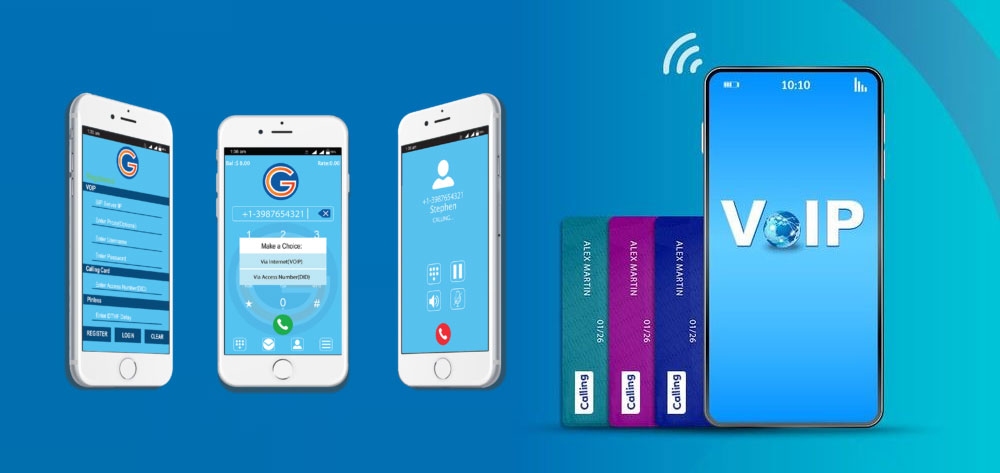
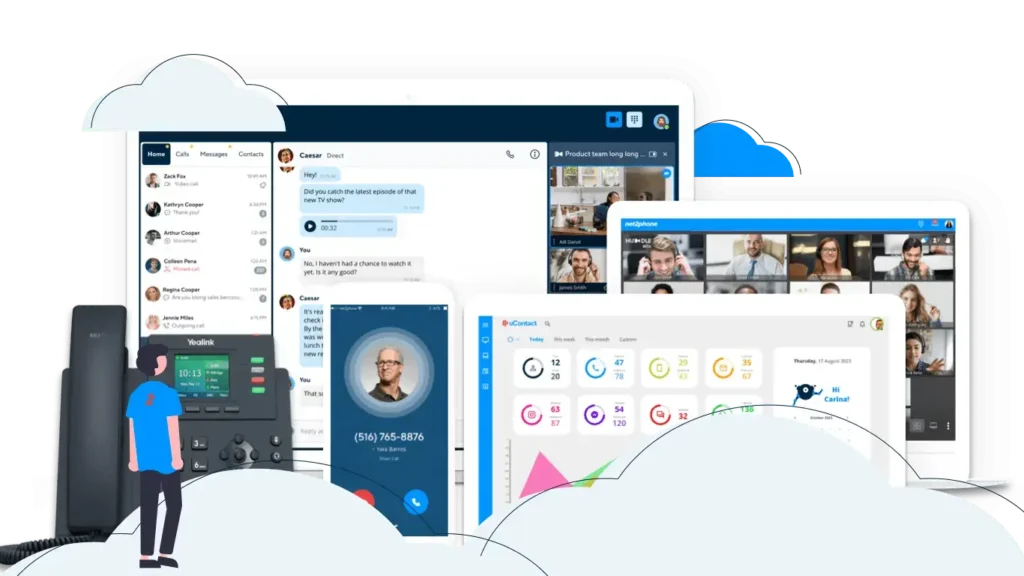
Managing voice communications across a distributed workforce used to mean one of two things: desk phones tethered to an office LAN, or an on-premises PBX system that required a dedicated server room, a maintenance contract, and a reason for employees to be physically present. Neither assumption holds up when half your team works remotely and the other half splits time between office, home, and client sites. A cloud mobile softphone changes the architectural foundation. The telephony stack moves off your premises, your users carry their business lines on devices they already own, and your IT team manages the entire system from a single administrative dashboard. That shift has operational, financial, and security consequences worth understanding before you evaluate vendors or finalize a deployment model. What Is a Cloud Mobile Softphone and How Does It Differ From Traditional Phones? A cloud mobile softphone is a software application that turns any internet-connected device—laptop, smartphone, tablet, or desktop—into a fully functional business phone by connecting it to a hosted cloud PBX rather than physical hardware or an on-premises server. The distinction matters more than it first appears. Traditional desk phones are purpose-built hardware endpoints that register to a PBX—either on-premises or hosted—over a local network. They require physical installation, network drops, power-over-Ethernet switches, and manual provisioning per device. On-premises phone systems can be expensive to set up because of the equipment needed—IP phones, SIP trunking, and a dedicated room in your office for the equipment. When something breaks, either your IT staff fixes it or a third-party vendor does, at cost. On-premises softphones replaced hardware endpoints with software clients, but they still registered to a PBX running inside your building. The calling infrastructure remained local: your server, your maintenance, your problem when a firmware update breaks the SIP stack at 2 a.m. A physical PBX phone system means anyone needing to make calls needs to physically be in the office—remote employees can’t dial in and make or receive calls away from their desks. Cloud softphones move the PBX itself off-premises. Softphones are cloud-based and enable remote business communications, whereas hardphones are premise-based and require employees to be physically in the office to access their business phone system. The phone system lives in the provider’s infrastructure—geo-redundant data centers, managed SIP servers, and cloud-hosted routing logic—while users connect through a lightweight app on the device of their choice. Hosted phone systems are more often more reliable than their traditional counterparts. Your hosted PBX provider is responsible for the maintenance, security, and general upkeep of your cloud phone system. That operational transfer is precisely what makes cloud softphones attractive to IT managers overseeing distributed teams: you offload infrastructure management without sacrificing feature depth. How Cloud Mobile Softphones Work: WebRTC, SIP Clients, and Cloud PBX Integration Cloud mobile softphones communicate using two primary protocol stacks: SIP-based clients that register directly to a cloud PBX, and WebRTC-based clients that route calls through a browser or native app. Understanding the architecture of each helps you make the right deployment decision for your team’s scale and requirements. SIP-Based Cloud Mobile Softphones Traditional mobile softphones introduced businesses to the power of voice-over-IP technology, transforming standard internet connections into sophisticated communication tools. These software-based phone systems operate through the SIP protocol, enabling voice communication over internet networks rather than traditional phone lines. In a cloud deployment, the SIP client on the user’s device registers to a hosted PBX—built on platforms like FreeSWITCH, Asterisk, or Kamailio—over the public internet. The signaling plane (SIP) handles call setup, teardown, and feature negotiation. The media plane (RTP) carries the actual voice packets. A Session Border Controller (SBC) typically sits between your users and the cloud PBX, handling NAT traversal, security enforcement, and protocol translation. Mobile Softphone settings are stored on a cloud server—the provisioning server. Once an agent starts a SIP softphone and logs in with their credentials, the softphone downloads its configuration settings from the server. It takes less than one second. Neither a system administrator nor an agent needs to enter any configuration settings. An agent has a preconfigured application and can start making calls immediately. SIP softphones offer the widest range of functions that are guaranteed to work with any cloud PBX, as well as with specialized server software for a call center. This makes them the preferred choice for organizations running high-volume calling environments, advanced IVR flows, or integration with legacy carrier infrastructure. WebRTC-Based Cloud Mobile Softphones WebRTC (Web Real-Time Communication) takes a different approach. Modern communication platforms powered by WebRTC deliver enhanced capabilities, including superior audio quality, seamless video integration, and robust security features. The technology operates natively within web browsers, eliminating the complexity associated with traditional softphone installations while providing more advanced features and better performance. The fundamental difference lies in WebRTC’s ability to establish peer-to-peer connections directly between browsers. This capability reduces latency, improves call quality, and enables more efficient data transmission compared to traditional softphone solutions. WebRTC’s architecture also includes built-in media processing capabilities and advanced codec support, ensuring superior communication quality across different devices and network conditions. Where WebRTC-based softphones need to connect to a PSTN carrier—for outbound calling to regular phone numbers—they rely on a backend bridge. The backend, running in the cloud or in a private Kubernetes cluster, converts WebRTC into regular VoIP (SIP) so calls can be exchanged with ordinary VoIP systems and carriers. This translation layer is invisible to the end user but critical to the architecture: it means WebRTC endpoints interoperate with SIP carriers, hosted PBXs, and PSTN gateways without requiring users to install SIP clients. With WebRTC, you can call and be called through your browser on your PC or Mac, or through a mobile application, from any location. With web-based solutions, businesses can easily expand to meet growing demand and effectively manage high call traffic. For organizations building or evaluating white-label softphone solutions, Gama Infotech offers cross-platform options—including Android Communicator for OTT VoIP deployments and an iPhone Softphone—designed to integrate with any SIP-compliant cloud PBX or softswitch. Why Distributed

Cloud Mobile Softphone Explained: Architecture, Deployment, and Operational Fit for Distributed Teams Read More »

what is voip

VoIP Softswitch Development and Implementation: A Technical Guide for CTOs and Telecom Architects

If you’re building or scaling a VoIP business, the softswitch isn’t just another component in your stack — it’s the decision engine that determines whether your infrastructure can support growth, deliver quality, and remain profitable over time. This guide is written for the technical and business leaders who make those architecture decisions: CTOs at ITSPs, telecom startup founders evaluating their first platform, and wholesale VoIP architects looking at a re-architecture. We’ll cover the full lifecycle: softswitch definition and architecture, class selection, protocol requirements, scalability design, build-vs-buy trade-offs, OSS/BSS integration, security and compliance, vendor evaluation, and realistic cost modeling. No filler, no vendor cheerleading — just the information you need to make defensible decisions. What Is a VoIP Softswitch? Definition, Architecture & Role in Modern Telecom A VoIP softswitch is a software-based platform that performs call routing, signaling control, and session management over IP networks — replacing the role once filled by dedicated TDM hardware switches. It sits at the heart of every carrier-grade VoIP deployment, making real-time decisions about where each call goes, which codec to use, and how to bill for it. According to AWS’s Real-Time Communication reference architecture, a softswitch provides the intelligence for establishing, maintaining, and routing voice calls within or outside the enterprise. Every subscriber must register with the softswitch to send or receive calls, and it continuously tracks subscriber state and reachability using supporting network components. Architecturally, a modern softswitch separates two planes of operation: The Signaling Plane handles call setup, modification, and teardown. It processes SIP (Session Initiation Protocol) messages, manages registration, enforces dial plans, applies routing logic, and interfaces with the billing system to track Call Detail Records (CDRs). This is where your business logic lives: Least Cost Routing (LCR), number translation (ENUM lookups), fraud rules, and quality-based routing all operate here. The Media Plane handles the actual voice packets. RTP (Real-time Transport Protocol) streams carry audio between endpoints, while the softswitch or an associated media gateway manages transcoding between codecs, handles NAT traversal, and enforces encryption via SRTP. In high-performance deployments, the media plane is deliberately separated from the signaling plane — running on dedicated media servers or RTP proxies — to prevent signaling bottlenecks from degrading audio quality. Between these two planes, a well-architected softswitch also incorporates a Session Border Controller (SBC) at the network edge. The SBC sits at the edge of the voice network, tracking all incoming and outgoing traffic across both control and data planes, absorbing malicious traffic before it can reach core softswitch infrastructure. Most modern SIP trunks are established through SBCs rather than direct connections to the core softswitch. Understanding this two-plane architecture matters before you make any procurement or build decision. A platform that conflates signaling and media processing on a single node will hit scalability limits much earlier than one that separates them — and retrofitting that separation later is painful. Class 4 vs Class 5 Softswitch: Which Does Your Business Need? The single most important architectural decision for any ITSP or carrier is whether you need a Class 4 softswitch, a Class 5 softswitch, or both. These aren’t just marketing labels — they represent fundamentally different traffic models, feature sets, and infrastructure requirements. Class 4 softswitches handle long-distance calls and wholesale traffic, focusing on routing calls across large networks, while Class 5 softswitches manage local call delivery and advanced features for end users. A call originating in one country is typically routed by a Class 4 softswitch to another country, where a Class 5 softswitch takes over to deliver the call to the recipient. Dimension Class 4 Softswitch Class 5 Softswitch Primary Function Wholesale transit routing between carriers and across long distances Retail voice delivery to end users (residential and business) Traffic Model High-volume, carrier-to-carrier, international long distance Local and national calls, PBX-style service delivery Key Features LCR, protocol transcoding, CDR generation, inter-carrier billing, fraud detection IVR, voicemail, call forwarding, calling cards, conferencing, auto-attendant, DID management Protocol Support SIP, H.323, MGCP — inter-network protocol conversion is essential SIP primarily, with SIP-to-PSTN gateway capability Scalability Focus Concurrent calls (thousands to tens of thousands), CPS (calls per second) Subscriber count, feature richness per user, multi-tenancy Typical User Wholesale VoIP carrier, international transit provider, Tier 1/2 operator ITSP, hosted PBX provider, UCaaS platform, residential VoIP provider Billing Model Per-minute wholesale billing, inter-carrier settlements Per-user monthly subscriptions, prepaid calling cards, usage-based Infrastructure Cost Higher — carrier-grade hardware or bare metal for peak concurrency Moderate — cloud-deployable, scales with subscriber base When to Use You route minutes for other carriers, run international traffic, or operate a wholesale termination business You sell phone numbers and features directly to businesses or consumers The practical implication: Class 4 softswitches are built to handle thousands of concurrent calls with minimal latency — this scalability makes them ideal for wholesale VoIP providers and international carriers. Class 5 systems trade raw call volume capacity for feature depth, managing per-user state like voicemail boxes, call queues, and IVR menus. A third option worth considering is a hybrid softswitch, which combines Class 4 transit capabilities with Class 5 subscriber management. This is the architecture most ITSPs eventually converge on as they grow: you need the retail features to win enterprise customers, but you also need efficient wholesale routing to control termination costs. The trade-off is complexity — hybrid platforms require more careful capacity planning and have more integration surface area to maintain. If you’re a startup with limited capital, start with Class 5 and purchase wholesale transit from an upstream carrier. Trying to operate Class 4 infrastructure at low traffic volumes is economically inefficient. If you’re a wholesale carrier or transit provider, Class 4 is your core platform and Class 5 features are unnecessary overhead. Core Components of a VoIP Softswitch System A production-grade VoIP softswitch is never a single process or binary — it’s a system of coordinated components. Understanding what each component does helps you evaluate vendor platforms honestly and design custom architectures that don’t have hidden single points of failure. SIP Proxy

VoIP Softswitch Development and Implementation: A Technical Guide for CTOs and Telecom Architects Read More »

Professional business phone on modern office desk representing VoIP telecommunications services. Photo by Dkn8-zPIbwo on Unsplash

White-Label VoIP: How Resellers and MSPs Can Launch a Branded Voice Service Without Building Infrastructure

For MSPs and telecom resellers, white-label VoIP offers a concrete path to recurring revenue without the capital cost, staffing, and timeline of building your own platform. You get a fully branded service — your logo, your pricing, your customer relationships — while an upstream provider maintains the infrastructure that keeps calls running. Here’s what the model actually involves and how to evaluate whether it’s right for your business. What Is White-Label VoIP? White-label VoIP is a hosted voice platform that a provider builds and maintains, but that you rebrand and resell under your own company name. To your customers, it looks and feels like your phone system — your domain, your invoices, your support line — not a third-party service. At its core, the model separates infrastructure ownership from commercial ownership. The upstream provider runs the softswitch (the software that routes SIP calls between endpoints), manages carrier interconnects, and handles uptime. You control the brand, set the pricing, bill the customer, and own the relationship. This is fundamentally different from an agent or referral arrangement. Agent and referral programs offer the lowest barrier to entry — you refer customers to a provider and receive a commission — but you have no control over pricing, the customer relationship ultimately belongs to the provider, and your commission is fixed regardless of the value you deliver. In a white-label model, you are not just referring business to a carrier. You become the brand, the biller, and the primary point of contact for your customers. Your backend partner handles the technical infrastructure, switching, uptime, compliance, and platform maintenance, while you own the commercial relationship and long-term revenue. The market context matters here. The global VoIP services market is currently estimated at $158.72 billion in 2024, with projections to reach as much as $361.53 billion by 2031, at a compound annual growth rate (CAGR) of 12.5%. That sustained growth creates durable demand — and white-label reselling is one of the most capital-efficient ways to capture a share of it. How White-Label VoIP Works: Infrastructure, Branding, and Revenue The mechanics are straightforward: you purchase voice service at wholesale rates and resell it at your own retail price, keeping the margin. The provider’s infrastructure runs invisibly underneath your brand. The Infrastructure Layer Every white-label VoIP deployment rests on a softswitch — the software engine responsible for establishing, routing, and terminating SIP sessions across the network. A softswitch is a component of a software-defined network (SDN) that helps connect different technologies, ensure call quality, and gather necessary metrics by establishing, maintaining, routing, and terminating sessions in VoIP networks. There are two classes relevant to resellers. Class 4 softswitches are designed for long-distance call routing between exchanges, primarily in a carrier-to-carrier environment, handling large volumes of voice traffic. Class 5 softswitches focus on local call routing and handle direct connections between individual users — landlines, mobile devices, or VoIP systems — managing features such as voicemail, call forwarding, and caller ID. Most white-label reseller programs are built on Class 5 infrastructure because it handles the feature-rich, end-user PBX capabilities that business customers expect. The provider also maintains Session Border Controllers (SBCs) that enforce security at the network edge, manage codec negotiation (G.711, G.729, Opus), and provide NAT traversal for remote endpoints. RTP (Real-time Transport Protocol) carries the actual voice media between parties, while SIP handles signaling. You don’t manage any of this — the provider does. The Branding Layer Most white-label VoIP programs include a cloud voice platform (PBX, users, call routing, apps), number services (new numbers, porting, toll-free, E911), administration tools (user management, roles, reporting), a defined support model, and a branding layer covering logos, portals, invoices, and emails. The depth of that branding layer is where programs diverge significantly. A genuine white-label arrangement ensures your upstream provider is invisible at every touchpoint — portal domains, caller ID display, email notifications, mobile app store listings, and invoice headers should all carry your identity. White-label softphone apps (iOS and Android dialers distributed under your brand) are a key part of this experience. At Gama Infotech, we develop custom-branded mobile dialers and softphone applications that resellers can deploy under their own name, giving end users a seamless branded calling experience across devices. The Revenue Model You purchase SIP trunking and voice services at wholesale rates from your platform partner, then resell those services to your customers at prices you determine, keeping the margin as profit. SIP trunking operates on a subscription model — customers pay monthly fees for their channels and usage. Once you acquire a customer, that revenue continues month after month for as long as they remain satisfied with your service. White-Label vs. Building Your Own VoIP Platform Building proprietary telecom infrastructure gives you maximum control — but it demands engineering depth, capital, and years of development time that most MSPs and telecom entrepreneurs cannot justify. Here’s how the two approaches compare across the dimensions that matter most to resellers: Factor White-Label VoIP (Reseller) Build Your Own Platform Time to market Days to weeks (platform is ready; you configure branding) 12–36+ months (softswitch dev, SBC setup, carrier interconnects, app development) Upfront capital Low to none — no infrastructure investment required High — servers, licenses, development salaries, NOC staffing Engineering team required Not required; provider handles SIP, RTP, SBC, and platform maintenance Required — SIP engineers, backend devs, QA, DevOps, security team Ongoing maintenance Provider manages updates, patches, uptime, and carrier relationships Full responsibility — OS updates, security patches, SIP interoperability testing Branding control Good — portals, invoices, softphone apps, domains carry your brand Complete — every layer is under your control Feature roadmap Dependent on provider release cycle; may lag behind your custom needs Full control; build exactly what your market requires Gross margin potential 50–70%+ on voice services (wholesale-to-retail spread) Very high long-term, but offset by substantial OpEx (staff, infra, compliance) Scalability Scales with provider infrastructure; no hardware procurement required Scales with your investment in capacity planning and data center redundancy Compliance burden Provider handles E911,

White-Label VoIP: How Resellers and MSPs Can Launch a Branded Voice Service Without Building Infrastructure Read More »

softswitch

VoIP Softswitch Explained: Components, Class 4 vs Class 5 Softswitch, and Real-World Use Cases

A VoIP softswitch is the central nervous system of any modern telecommunications network. If you’re evaluating how to launch a VoIP business, upgrade carrier infrastructure, or build a call center platform, understanding what a softswitch does—and which type you need—is essential before making any technical or vendor decisions. What Is a VoIP Softswitch? A softswitch (software switch) is a software-based system that manages voice traffic, call routing, and session control in VoIP networks—replacing the specialized hardware of traditional telephone exchanges. Unlike legacy circuit-switched systems that required dedicated physical connections, a softswitch handles call setup, maintenance, routing, and termination entirely through software running on standard computing platforms. In practical terms, when a VoIP phone initiates a call, the softswitch receives the signaling request, authenticates the caller, determines the optimal route to the destination, and establishes the connection. It then monitors the call and releases resources when the session ends. This software-based approach delivers significant advantages in scalability, flexibility, and cost efficiency compared to hardware-dependent alternatives. At Gama Infotech, we’ve seen firsthand how choosing the right softswitch architecture can make or break a telecom startup’s time-to-market and total cost of ownership. Core Components: Signaling, Media Gateway, Routing Engine, and Billing Interface Every VoIP softswitch comprises four essential subsystems that work together to deliver reliable voice services. Understanding these components helps you evaluate vendor offerings and architect your network appropriately. Signaling Controller The signaling controller handles call setup, modification, and teardown using protocols like SIP (Session Initiation Protocol) or H.323. When a user dials a number, the signaling controller receives the request, validates credentials, and coordinates with other network elements to establish the session. It’s the “brain” that interprets what callers want and orchestrates the connection. Media Gateway The media gateway handles the actual voice data streams. It converts media between different formats—for example, translating VoIP packets into formats compatible with traditional PSTN lines, or transcoding between different audio codecs (G.711, G.729, etc.). This component ensures seamless communication between IP networks and legacy telephony infrastructure. Routing Engine The routing engine determines the optimal path for each call based on configurable rules. Common routing strategies include: Billing Interface The billing interface generates Call Detail Records (CDRs) that capture call metadata: caller ID, destination, duration, codec used, and routing path. These records feed into billing systems for invoicing customers, reconciling carrier costs, and generating business intelligence reports. For wholesale carriers, accurate real-time billing is critical for margin management. Class 4 vs Class 5 Softswitch: Key Differences and When to Use Each The distinction between Class 4 and Class 5 softswitches mirrors the traditional PSTN hierarchy. Class 4 handles carrier-to-carrier transit traffic, while Class 5 serves end users directly. Most VoIP networks require both, working in tandem. Characteristic Class 4 Softswitch Class 5 Softswitch Primary Function Long-distance/wholesale routing between carriers Local call routing and end-user services Target Users Wholesale carriers, telcos, VoIP aggregators Retail VoIP providers, enterprises, call centers Call Volume High-volume trunk traffic (millions of minutes) Lower volume, higher feature complexity Key Features Protocol conversion, transcoding, LCR, CDR generation IVR, voicemail, call forwarding, caller ID, conferencing Routing Scope International/inter-carrier routing Local/regional routing to end devices Feature Depth Fewer features, optimized for throughput Rich PBX features for end-user experience Typical Metrics Calls per second (CPS), concurrent calls, latency User accounts, feature utilization, call quality When to Use Class 4 Choose a Class 4 softswitch when you’re operating as a wholesale VoIP provider, interconnecting with multiple carriers, or routing high volumes of long-distance traffic. The focus is on throughput, protocol interoperability, and cost-efficient routing rather than end-user features. When to Use Class 5 Choose a Class 5 softswitch when serving end users directly—whether residential customers, small businesses, or enterprise clients. Class 5 delivers the PBX-style features users expect: auto-attendant, call waiting, voicemail, caller ID, and more. Hybrid Deployments Many operators deploy both classes together. A retail VoIP provider might use Class 5 to serve subscribers locally, then hand off international calls to a Class 4 switch that routes to wholesale carriers. This architecture separates concerns and allows each component to be optimized for its specific role. Protocols Explained: SIP, RTP, ENUM, and H.323 VoIP softswitches rely on several protocols working together to establish, maintain, and transport voice sessions. Here’s what each does and why it matters for your architecture decisions. SIP (Session Initiation Protocol) SIP is the dominant signaling protocol in modern VoIP networks. It handles call setup, modification, and termination using a text-based format similar to HTTP. SIP’s simplicity and flexibility have made it the protocol of choice for most new VoIP deployments, from enterprise PBX systems to carrier-grade networks. Key SIP characteristics include: RTP (Real-time Transport Protocol) While SIP handles signaling, RTP carries the actual voice (or video) data. RTP provides mechanisms for sequencing packets, timestamping, and payload identification—essential for reconstructing audio streams that arrive out of order or with variable delay. RTCP (RTP Control Protocol) works alongside RTP to provide quality feedback and statistics. H.323 H.323 is an ITU-T protocol suite that predates SIP. It remains widely used in video conferencing systems and some carrier networks. H.323 is more complex than SIP, using binary encoding and requiring gatekeepers for address resolution. While SIP has largely replaced H.323 for new deployments, many softswitches still support H.323 for interoperability with legacy systems. ENUM (E.164 Number Mapping) ENUM bridges traditional telephone numbering with IP addressing. It uses DNS to translate E.164 phone numbers into URIs (like SIP addresses), enabling direct VoIP routing without PSTN interconnection. For carriers, ENUM can reduce termination costs by discovering VoIP-reachable destinations and routing calls over IP rather than through PSTN gateways. Real-World Use Cases for VoIP Softswitches Understanding how different organizations deploy softswitches helps clarify which architecture fits your business model. Wholesale VoIP Carriers Wholesale carriers aggregate traffic from multiple retail providers and route it to termination partners worldwide. They rely on Class 4 softswitches optimized for high throughput, sophisticated LCR algorithms, and real-time margin monitoring. Key requirements include: Retail VoIP Providers Retail providers serve end customers—residential users, SMBs, or enterprises—with

VoIP Softswitch Explained: Components, Class 4 vs Class 5 Softswitch, and Real-World Use Cases Read More »

opensips kamillio

What Is a Softswitch and Why It Matters in a VoIP Network

A softswitch is the call-control layer of a Voice over Internet Protocol, or VoIP, network. It manages signaling, routes calls, applies policy, and coordinates how sessions are established and terminated without relying on traditional hardware switching. For businesses building carrier, enterprise, or wholesale voice platforms, it is one of the core systems that determines service quality, scalability, and operational control. At Gama Infotech, we position a softswitch as more than a routing engine. In practical deployments, it is the software intelligence that connects SIP endpoints, IP PBX systems, gateways, billing platforms, monitoring tools, and sometimes legacy public switched telephone network connections into one manageable service layer. What a softswitch actually does A softswitch controls calls rather than carrying the voice media itself. Its main job is to decide how a session should be handled, which destination it should reach, what rules apply, and how connected systems should participate in the call flow. In most VoIP environments, the softswitch works with signaling protocols such as SIP, while the media path uses RTP or Secure RTP depending on the deployment. In hybrid networks, it can also coordinate with media gateways that translate between IP traffic and legacy telecom signaling or time-division multiplexing infrastructure. Typical softswitch responsibilities include user registration, authentication, least-cost or policy-based routing, failover logic, interconnection with carriers, session management, call detail record generation, and service logic for features such as forwarding, IVR, conferencing, and number translation. How a softswitch fits into VoIP architecture A softswitch sits in the control plane of the network. It separates call intelligence from dedicated switching hardware, which gives operators and service providers more flexibility when scaling services, adding features, or integrating external systems. A typical deployment may include SIP phones or softphones, a session border controller, a media gateway, a billing platform, an OSS/BSS layer, and monitoring systems. The softswitch coordinates call setup between these components and enforces the business rules behind each session. That is why it is often central to both technical performance and commercial operations. Common components around the softswitch In enterprise and carrier environments, a softswitch is often deployed alongside an IP PBX, session border controller, media server, media gateway, and analytics stack. Each component has a distinct role, but the softswitch is typically where routing logic, signaling control, and feature orchestration come together. Component Main role in the voice network Softswitch Controls call setup, routing, policy, and session management Session Border Controller Protects network edges, manages interoperability, and enforces signaling and media policies Media Gateway Connects IP voice traffic with legacy TDM or PSTN environments IP PBX Provides enterprise telephony features for internal users and extensions Billing or OSS/BSS Handles rating, account management, reporting, and service operations Why operators and businesses use softswitches The main value of a softswitch is control with flexibility. It allows providers to launch voice services faster, support multiple business models, and scale capacity using software and standard server infrastructure instead of depending entirely on proprietary switching hardware. For a VoIP startup founder, that means faster service launch and simpler service packaging. For a telecom operator, it means centralized routing logic, multi-carrier interconnection, and better control over redundancy. For a call center or enterprise IT team, it means more consistent call handling, better visibility, and easier integration with CRM, recording, and reporting systems. Business and technical benefits In our experience, buyers usually care about six outcomes when evaluating a softswitch platform. First, scalability. A software-based architecture makes it easier to add capacity as traffic grows. Second, interoperability. SIP-based environments often need to connect with multiple carriers, PBX platforms, gateways, and endpoints. Third, service agility. New routing logic and service features can be introduced without replacing switching hardware. Fourth, visibility. Real-time monitoring and call records improve troubleshooting and operations. Fifth, integration. Billing, provisioning, fraud controls, and customer portals depend on reliable interfaces. Sixth, resilience. High-availability design reduces the impact of failures on live traffic. What makes Gama Infotech’s softswitch relevant Gama Infotech’s softswitch is designed for organizations that need a carrier-grade call control platform without the rigidity of legacy switching models. The focus is on efficient session establishment, routing, management, and termination across modern VoIP environments. The platform is built to support multiple services over a unified software-driven architecture, including voice and video services, with room for broader service delivery depending on the deployment design. Because call control is separated from traditional hardware, businesses can expand services and integrate third-party applications with less operational friction. Its practical strengths include scalable service delivery, integration flexibility, and real-time monitoring to help operations teams maintain network performance. Those capabilities matter when you are supporting wholesale routes, enterprise customers, call center workloads, or white-label VoIP offerings that cannot afford inconsistent session handling. When a business should consider a softswitch upgrade If call routing has become difficult to manage, carrier integration is slowing launches, or feature requests require workarounds across multiple systems, it is usually time to review the switching layer. These problems rarely stay isolated; they affect support costs, service quality, and revenue expansion. Common triggers include frequent routing changes, expansion into SIP trunking or wholesale voice, migration from legacy systems, multi-tenant service needs, high call volumes, weak reporting, or the need to connect CRM, billing, WebRTC, or customer self-service portals to the voice stack. If you are experiencing these symptoms, our team at Gama Infotech can help. What to evaluate before choosing one The right softswitch is not just the one with the longest feature list. It is the one that fits your traffic model, integration needs, failover requirements, support workflow, and growth plan. Here is what to consider: protocol support such as SIP and gateway interoperability, routing flexibility, multi-tenant capability, high-availability options, fraud controls, call detail record access, API readiness, codec support, monitoring visibility, and how easily the platform connects to billing, CRM, and provisioning systems. CTOs should also look closely at redundancy design, geo-distribution options, and operational observability before making a platform decision. The bottom line A softswitch is the operational brain of a VoIP network. It

What Is a Softswitch and Why It Matters in a VoIP Network Read More »

voip phone system

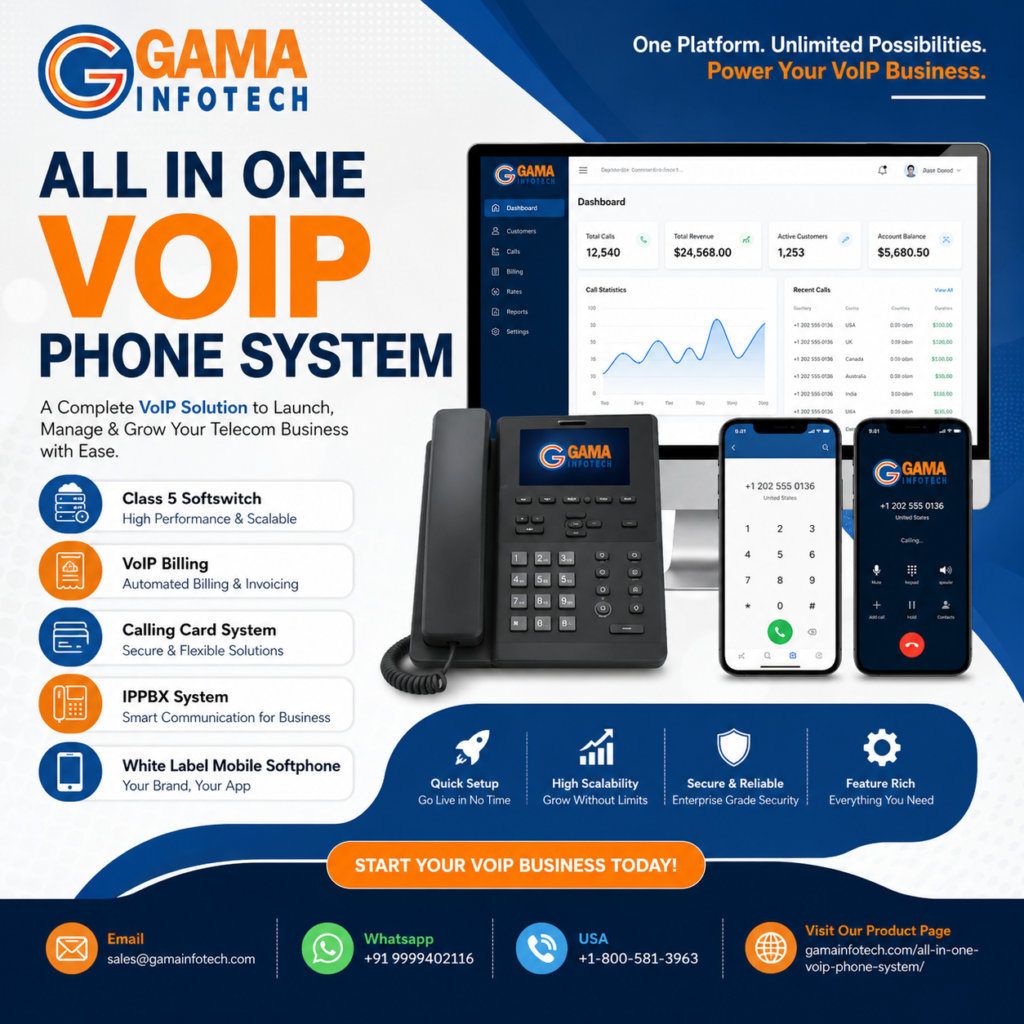
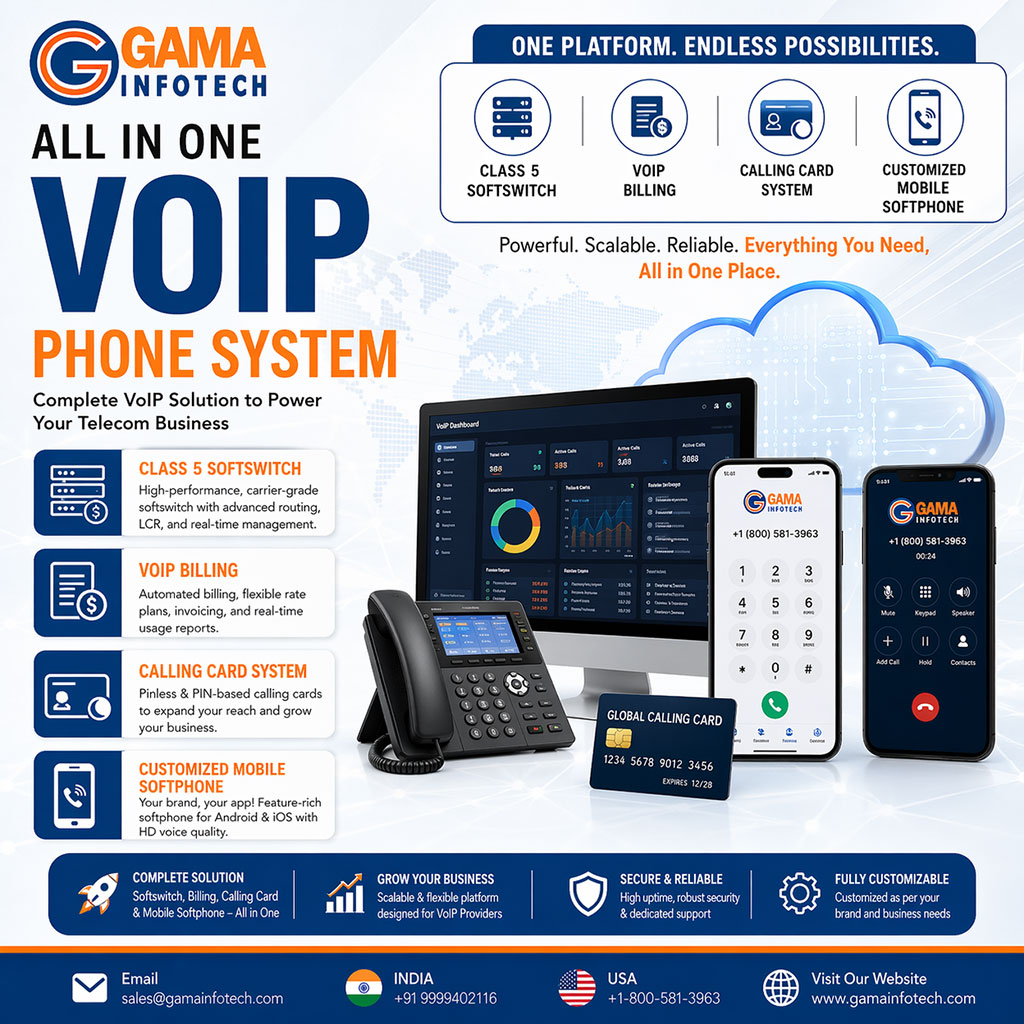
All-In-One VoIP Phone System: Softswitch, VoIP Billing & Mobile Softphone Solution

In today’s fast-growing telecom industry, businesses are rapidly shifting toward VoIP solutions to reduce costs and improve communication efficiency. If you are planning to start or scale your telecom business, an All-in-One VoIP phone system is the smartest investment. A complete VoIP platform combines essential components like a softswitch, billing system, mobile dialer, and calling card solution—everything you need in one place. What is an All-In-One VoIP Phone System? An All-In-One VoIP Phone System is a fully integrated communication platform that enables businesses to manage voice calls over the internet. Instead of using multiple tools, this system provides a centralized solution for routing, billing, and managing calls efficiently. Platforms on the Google Play Store often rely on such systems to power mobile softphones and communication apps. Key Components of the System 1. Softswitch (Core Engine) The softswitch is the backbone of any VoIP system. It manages call routing, signaling, and connectivity between users. Benefits: 2. VoIP Billing System A powerful billing system ensures accurate call tracking and revenue management. Features: 3. Calling Card System Calling card solutions allow users to make international calls using prepaid credits. Advantages: 4. Customized Mobile Softphone A white-label mobile softphone lets your brand reach users directly via smartphones. Available on platforms like Google Play, these apps enable users to make calls anytime, anywhere. Key features: Why Choose an All-In-One VoIP Solution? Cost-Effective : Reduce infrastructure and operational costs compared to traditional telecom systems. Scalable : Easily expand as your business grows. White Label Ready : Launch your own branded VoIP service. Global Reach : Connect users worldwide with low-cost international calling. How to Start Your VoIP Business Security & Performance Modern VoIP systems are built with advanced security protocols to ensure: An All-In-One VoIP Phone System is the perfect solution for businesses looking to enter or expand in the telecom market. By combining softswitch, billing, mobile apps, and calling card systems, you get a powerful, scalable, and cost-efficient platform. Whether you’re a startup or an established provider, investing in a complete VoIP solution can help you achieve long-term success. Start your VoIP business today with a complete solution: sales@gamainfotech.comIndia: +91 9999402116USA: +1-800-581-3963https://gamainfotech.com/all-in-one-voip-phone-system/

All-In-One VoIP Phone System: Softswitch, VoIP Billing & Mobile Softphone Solution Read More »

allinonevoipphonesystem

All-in-One VoIP Phone System: The Complete Solution for Modern Telecom Businesses

In today’s fast-evolving telecom industry, businesses need a reliable, scalable, and feature-rich communication system to stay competitive. An All-in-One VoIP Phone System brings together everything you need—Class 5 Softswitch, VoIP Billing, Calling Card System, and Customized Mobile Softphone—into a single powerful platform. At Gama Infotech, we provide a complete VoIP solution designed to help telecom operators, startups, and enterprises streamline operations, reduce costs, and increase profitability. What is an All-in-One VoIP Phone System? An All-in-One VoIP Phone System is a unified communication platform that combines multiple VoIP components into one integrated solution. Instead of managing separate systems, you get everything in one place: This eliminates complexity and improves efficiency while delivering a seamless experience to your customers. Key Components of Our VoIP Solution 1. Class 5 Softswitch The Class 5 Softswitch is the core of your VoIP business. It manages call routing, user authentication, and real-time call control. Key Features: VoIP Billing System A powerful billing system is essential for revenue generation and management. Features include: Calling Card System Expand your services with a robust calling card platform. Benefits: Customized Mobile Softphone Take your services mobile with a fully branded softphone app. Highlights: Why Choose an All-in-One VoIP Solution? 1. Cost Efficiency Managing multiple systems can be expensive. An integrated solution reduces infrastructure and maintenance costs. 2. Easy Management Control everything—from routing to billing—via a single dashboard. 3. Scalability Easily scale your telecom business as your customer base grows. 4. Faster Deployment Launch your VoIP services quickly without complex integrations. 5. Better User Experience Provide seamless communication with high-quality voice and reliable connectivity. Who Can Benefit from This Solution? This VoIP system is ideal for: Why Choose Gama Infotech? At Gama Infotech, we specialize in delivering customized VoIP solutions tailored to your business needs. What sets us apart: An All-in-One VoIP Phone System is the perfect solution for businesses looking to simplify operations and maximize revenue. By combining softswitch, billing, calling card system, and mobile softphone into one platform, you gain complete control over your telecom business. If you’re ready to launch or upgrade your VoIP services, Gama Infotech is here to help you every step of the way.

All-in-One VoIP Phone System: The Complete Solution for Modern Telecom Businesses Read More »

softswitch

Understanding VoIP Softswitch: The Backbone of Modern Telecommunication

As the telecom industry shifts towards IP-based communication, softswitch technology has become a critical component of modern VoIP infrastructure. At Gama Infotech, we deliver robust softswitch solutions designed for performance, scalability, and reliability. What is a VoIP Softswitch? A VoIP softswitch is a software-based switching system that manages call routing, signaling, and control in VoIP networks. It replaces traditional hardware switches and enables efficient communication over IP networks. Core Functions of a Softswitch Advantages of Using a Softswitch Softswitches offer flexibility, scalability, and cost-efficiency. Service providers can easily expand their network, manage traffic, and deliver high-quality voice services without heavy infrastructure investments. Gama Infotech Softswitch Solutions Our softswitch platforms are designed to support both Class 4 and Class 5 VoIP services. With advanced routing, real-time billing integration, and secure architecture, Gama Infotech ensures reliable and high-performance communication systems.

Understanding VoIP Softswitch: The Backbone of Modern Telecommunication Read More »